
This house has lived several lives. It began in 1783 as a farmhouse owned by James Townsend, a name woven deep into Long Island history, and was reworked in the early twentieth century by the architecture firm Hewitt and Bottomley. Later owners chased something more modern, and by the time designer Amal Kapen arrived, much of the original character had been ripped out. Her brief: make the house feel true to itself again, and give a young family a home they'd actually want to spend time in.
Amal plans a room the way the old masters painted a canvas. Stand in front of a great painting and your eye moves — color and objects lead it around until it lands exactly where the artist intended. In principle, that means one star per room; in practice, she allows herself a few. And she is firmly on the side of color.
“I think it's easier to decorate with color than an absence of color, because when you have no color, you need a lot of stuff to make a statement.”
The library is the proof. By Amal's count it holds about 20 patterns, and you'd never guess it. What holds it all together is a disciplined palette of rust, yellow, blue, and orange, repeated until the patterns read as a single story. "Rooms eat pattern for breakfast," she says. That palette carries well beyond the library door: the rust climbs the stairs as a striped runner set against green walls, and the dining room picks up the same family of colors with a greener lean, so the house reads like chapters of one book.
Low ceilings come with a 1783 farmhouse, and Amal met them with what she calls a little trickery. In the living room, furniture stays low-slung and art hangs lower than usual, creating an illusion of height, while the colors are softened just enough to suit the age of the architecture. In the entry, which was low, white, and a little sad, she wallpapered the ceiling to camouflage it. In the homeowner's office, a single green envelops every surface until the eaves simply disappear. Upstairs, Colefax and Fowler wallpaper wraps the primary bedroom's eaves, with the trim painted in a color pulled straight from the paper — a move she makes often, because a jumble of colors and angles never lets the eye rest.
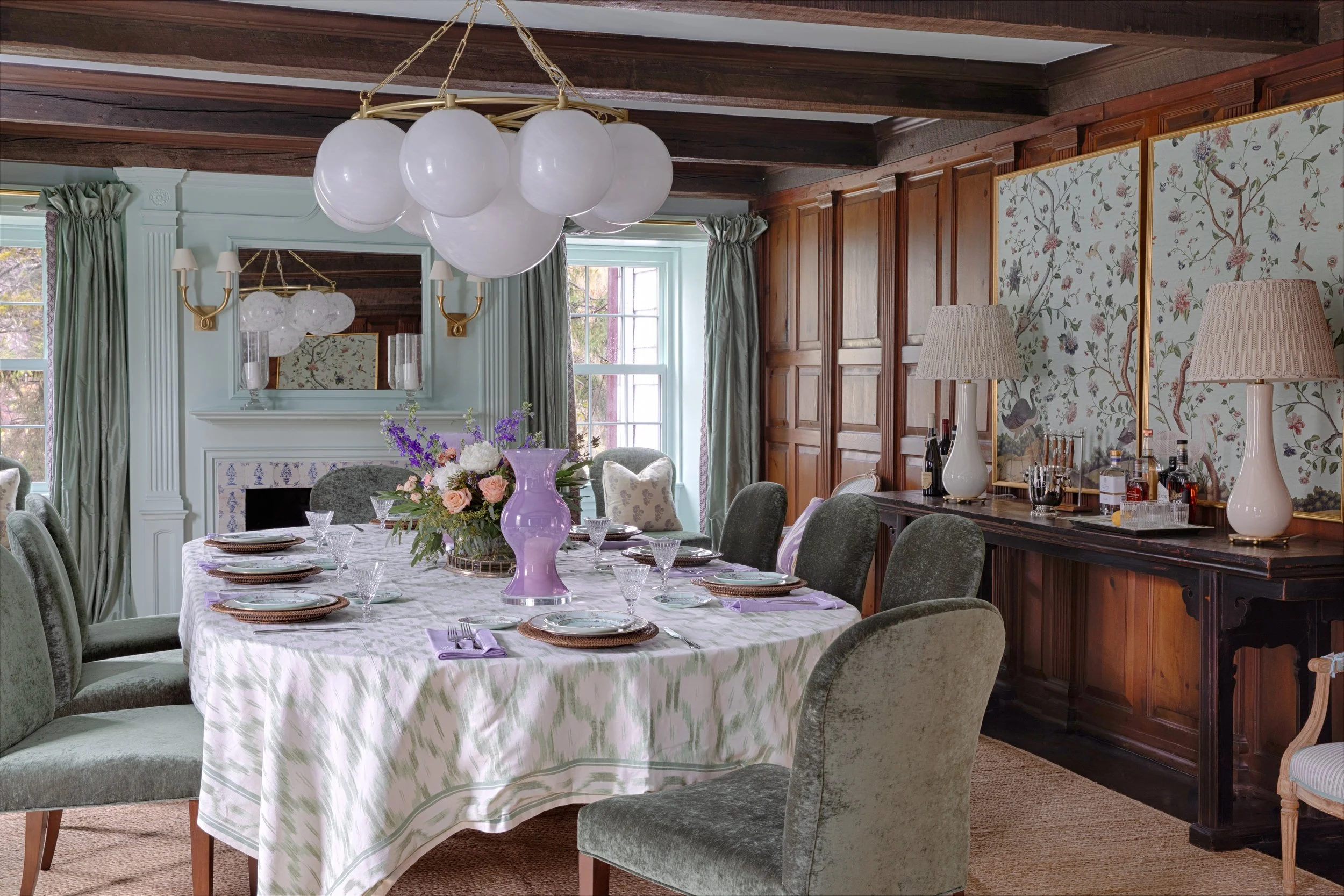
Where original features survived, she treated them as precious. "Once you lose those historical elements, they're gone forever," she says. The dining room keeps its original paneling and Hewitt and Bottomley–era beams, softened with a Schumacher wallpaper, and the original fireplace still wears its Delft tiles. In the living room, an alcove keeps its curved glass — every pane original — near a Thomas Cole painting framed by molding that runs slightly crooked. There's nothing straight in an old house, as Amal puts it. Where the character was already gone, she put some back: the library's bare brick became a simple fireplace in keeping with the architecture, and an empty wall in the dining room now holds a sunken antique mirror.
She reuses just as readily. A hand-painted tiled mantel moved from a bedroom into the new green office, where it looks as though it has always been. Closet doors from one side of the primary bedroom became the doors of a brand-new closet on the other, and leftover dining room wallpaper was framed and hung as art. Waste not, want not, is how she sums up her philosophy these days.
With two kids in the house, storage turned up in unlikely places. Wallpapered doors in the entry conceal deep cupboards, and a clunky radiator cover was redesigned to pass as furniture. The library's open shelves gained lower cabinets fronted with radiator grilles, plus a pull-down unit Amal devised with her carpenter. A once all-white powder room now has a tiny built-in bench where the kids can put on their shoes, and in the primary suite she made the bedroom smaller to fit the closet it never had.
The son's bedroom, carved out of a former laundry room and hallway, is a lesson in mixing high and low. A mother of two boys herself, Amal knows whatever goes in will eventually get broken. Pottery Barn bunk beds are painted in the trim color, Pooky lampshades add a cheerful designer moment without the price tag, and a playful elephant came from Amazon, all finished with custom bedding from Legacy Linens. The DHT episode walks through every room of this house — a farmhouse given back its history, one color at a time.